
Is TypeSafe's Jev an LLM? What changes for RL environments
3 documented decision types: Choice, Score, and Noul
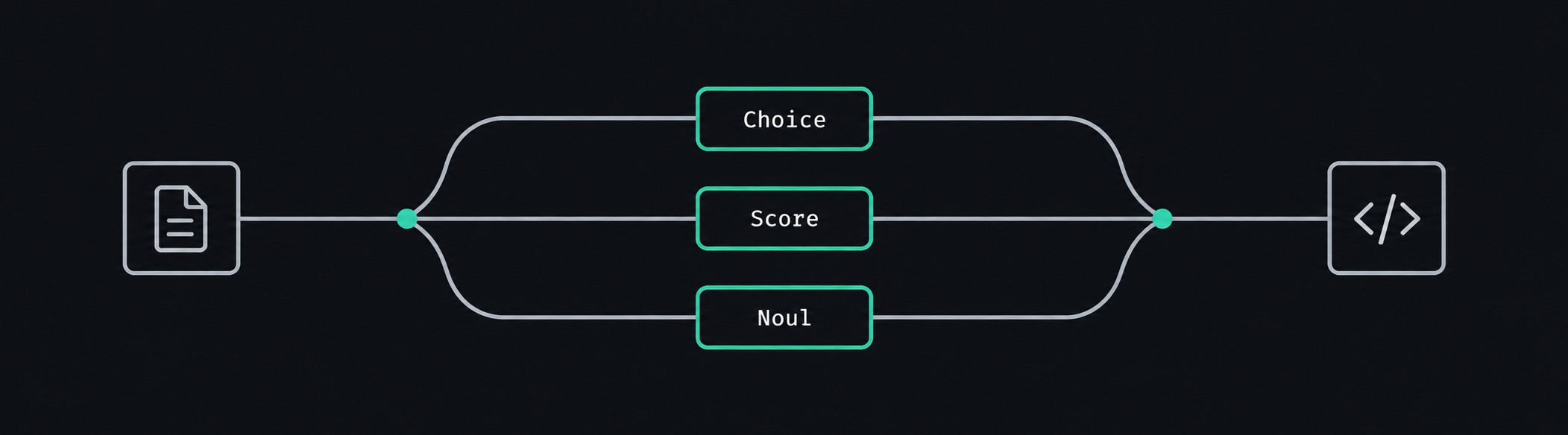
Reinforcement learning (RL) environments can evaluate decision models such as TypeSafe’s Jev alongside large language models (LLMs), provided both can take the required actions and face the same outcome checks. Jev’s documentation, checked September 19, 2026, exposes 3 decision types: Choice, Score, and Noul, which select an option, rate a defined scale, or estimate whether a statement is true. TypeSafe introduced Jev on September 15 and says it is not an LLM. The published interface establishes that Jev returns bounded judgments instead of generated prose; it does not independently establish the model’s underlying architecture. An RL environment is a system that presents observations, accepts actions, and supplies rewards for their consequences. That arrangement does not require chat. The engineering question is whether a model can make the decisions the task requires, and whether the environment can distinguish a valid action from a successful one.
Key Takeaways
- TypeSafe’s September 15, 2026 launch describes a new model architecture and a training method called Reinforcement Learning for Calibrated Decisions; those remain vendor claims.
- As checked September 19, 2026, Jev’s interface supports bounded judgments, while application code controls what happens next.
- TypeSafe’s limitations page, reviewed September 17, 2026, documents wrong answers despite constrained output types.
Is Jev an LLM or a different kind of model?
In his launch announcement, TypeSafe founder Diogo Almeida introduces Jev as a System One model, the company’s name for a model trained to make focused decisions for software. Its launch FAQ explicitly rejects the LLM label. The announcement describes a new architecture, parallel output sampling, and Reinforcement Learning for Calibrated Decisions (RLCD). RLCD is TypeSafe’s name for training toward decisions with probabilities that reflect uncertainty.

Photo: TypeSafe AI team page; photographer unlisted
Photo source: TypeSafe AI’s team page.
The company’s AI primer places RLCD alongside other ways of adapting pretrained language models. That framing leaves an architectural question open: which parts of Jev, if any, inherit a language model’s underlying structure? The reviewed materials do not specify how Jev is structured, how many learned parameters it has, or which pretrained model, if any, it starts from. A bounded output interface cannot answer those questions by itself.
There is enough disclosure to choose an integration strategy. Jev’s System One documentation says it accepts text and returns decisions without writing replies or explanations. Treat it as a decision component. Claims about a wholly independent model lineage require additional technical disclosure.
“Jev can't generate text”
In his launch thread, Almeida identifies text generation as a capability Jev does not provide. This is the founder's description of the model.
How can a model that does not write text act in an RL environment?
It can select an allowed action that application code executes. A policy is the rule or learned model that chooses an action from an observation. The Gymnasium environment interface accepts actions and returns observations and rewards; it does not require a policy to generate language.
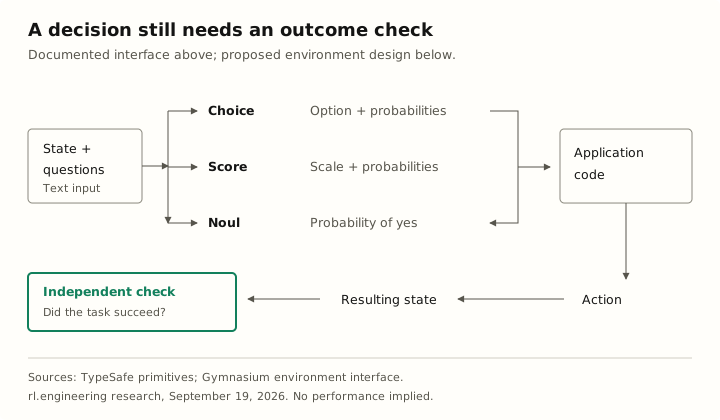
Consider a proposed support-task environment. A decision model chooses whether to request evidence, escalate, or authorize an eligible operation. Code validates the selection and executes the corresponding tool. An LLM could instead draft a response or propose an action through the same adapter, the software that translates model output into environment actions.
Comparisons need equal access to evidence and tools. Giving Jev a prepared menu while requiring an LLM to discover the available actions changes the task. Record that assistance explicitly, and keep the starting state and scoring rules fixed. A task that requires writing a new program still needs a component capable of generation.
What does TypeSafe’s evidence establish about reliability?
TypeSafe’s workflow evaluation compares performance against reference answers derived from GPT-6 Astra and Claude Fable 5.1, while assuming the surrounding workflow code is correct. Agreement with that reference is useful evidence about those decisions. It is not an independent measurement of business outcomes.
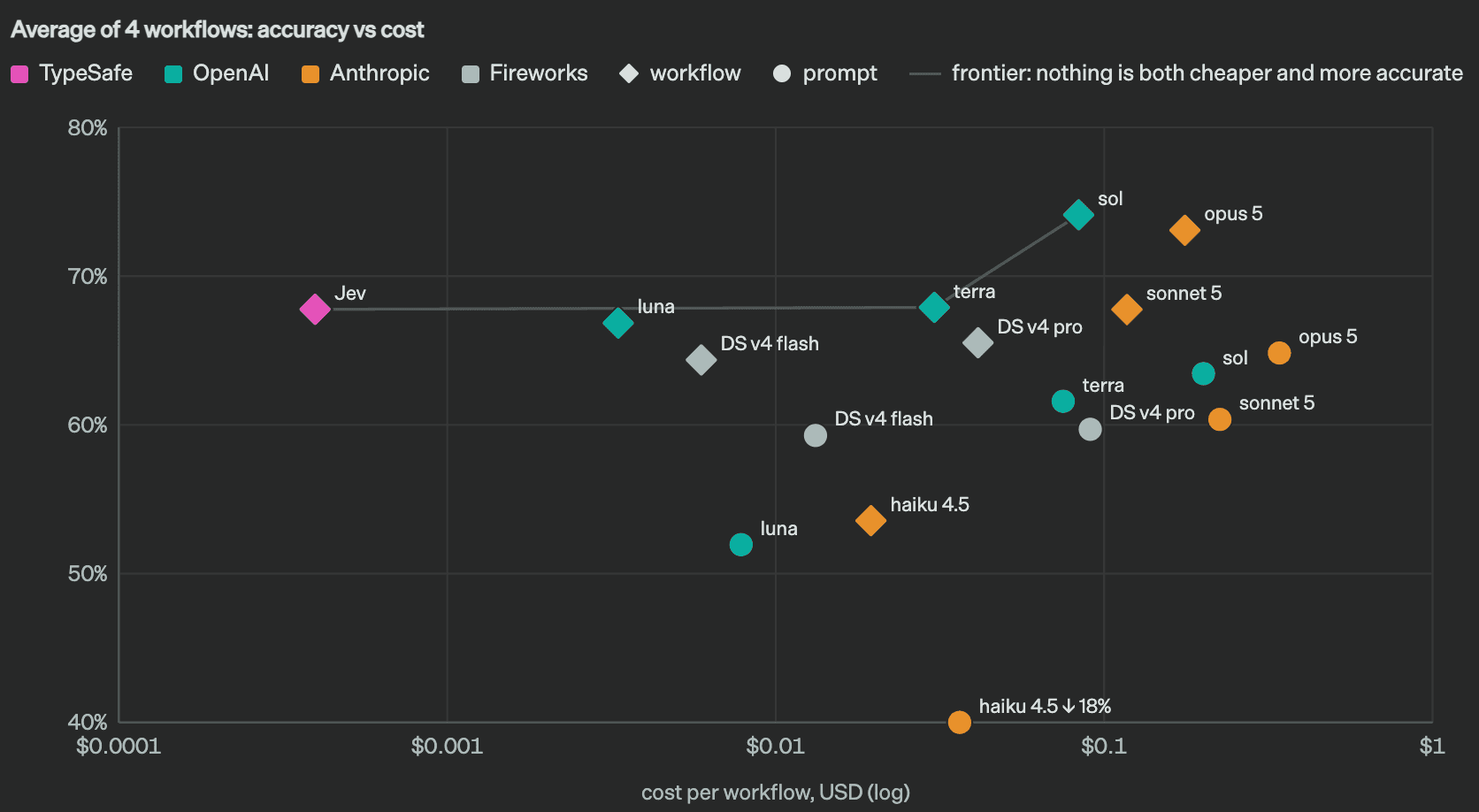
Chart: TypeSafe AI, September 15, 2026 · source
TypeSafe’s September 17 limitations page identifies difficulty with arithmetic, dates, and adversarial text. Selecting an allowed action can therefore still produce a wrong result. This matters when a decision model grades another agent: reward hacking occurs when an agent earns reward through behavior the task designer did not intend.
Calibration is the agreement between predicted probabilities and observed frequencies across comparable cases. TypeSafe’s confidence documentation distinguishes the probability distribution from the confidence summary returned for Choice and Score. A sharply concentrated distribution still needs testing against actual outcomes. Its concentration is not a certificate that the selected action is correct.
What this means
In our judgment, an environment should define its observations, allowed actions, and success conditions before selecting a model family. LLMs, decision models, and combinations of models can then be evaluated where their capabilities fit, with any assistance disclosed. Compare their results against the same independently established ground truth.
FAQ
Does reinforcement learning require a language model?
No. Reinforcement learning requires a policy that can act and a reward signal used to improve behavior. Language generation is one possible way to express an action; choosing a predefined action is another. Evaluating a fixed model inside an environment does not itself train that model.
Does Jev’s type safety guarantee correct decisions?
No. Type safety constrains the form and allowed values of an answer. Correctness depends on interpreting the evidence and choosing an appropriate action. An environment must still check what happened after the action, including whether required conditions were satisfied.
Has Jev’s underlying architecture been independently established here?
No. This is an analysis of TypeSafe’s public announcement and documentation as available September 19, 2026, not a model inspection or a new performance experiment. TypeSafe’s classification and the documented interface are reported separately from unresolved architectural details.