
AI agents solved a Millennium Prize problem. A mathematician says they raced him to it
About 10,000 coordinating AI agents on one problem, per OpenAI's announcement
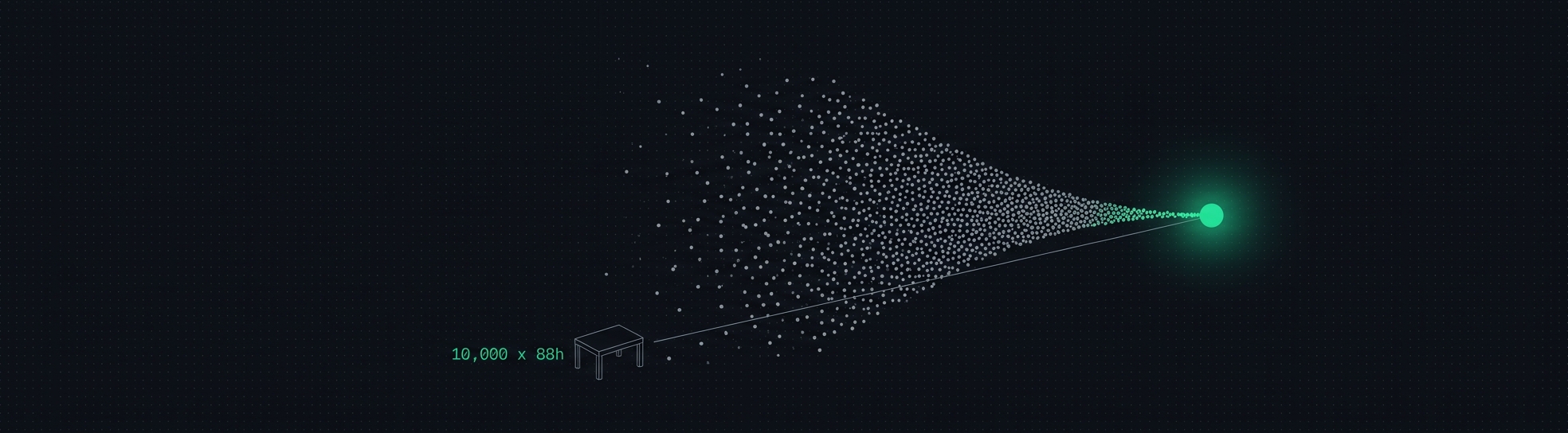
On September 8, 2026, OpenAI announced a solution to the Navier-Stokes Millennium Prize problem, and by the company’s own figures the proof took around 10,000 coordinating AI agents 88 hours. When a lab can point that many agents at one problem, unpublished expert work becomes training input, and provenance (the record of who produced a piece of expert work, and under what agreement) becomes the priced feature of expert data. Levent Alpöge, a Harvard mathematician working on the same problem, stated publicly that he had contacted OpenAI on September 2 because he believed the company had learned about his private work and had assembled a group to compete with him. Sebastien Bubeck of OpenAI replied that nothing was locked and that the company had been willing to talk. The same night, a pretraining researcher resigned from Anthropic over the race itself. The training loop this site tracks (models learning from scored attempts at expert-built tasks) just consumed its first Millennium-grade expert problem, and the fight is about who owned the inputs.
Key Takeaways
- OpenAI says agent teams produced an analytical proof, with a machine-checked Lean formalization, that Navier-Stokes solutions can break down in finite time.
- The dispute concerns provenance: a mathematician alleges the lab knew about and raced his unpublished work, an OpenAI researcher disputes that account, and neither claim has been adjudicated.
- For the expert-data market, provenance just became a priced feature: in our judgment, labs will pay for expert work that is consented and attributed, and avoid work that was scooped.
What did OpenAI announce?
OpenAI’s announcement says a group of agents, running on an unreleased internal model, produced a proof that a Navier-Stokes solution can blow up in finite time: a spinning vortex that spirals inward until the equations break down. The Navier-Stokes problem asks whether the equations describing fluid flow always behave, or whether a solution can develop such a singularity. It is one of the seven Millennium Prize problems, each carrying a $1 million award. The proof comes with a Lean formalization, meaning a computer has checked every logical step, which removes most doubt about correctness, so the dispute is about who knew what, not about the proof.
“The proof was produced by a group of agents”
What is the provenance dispute?
Levent Alpöge posted his account on September 9: he says he contacted OpenAI on the night of September 2, telling the company he believed it had learned about his private work on the problem, and that it had recently assembled a group to compete. His post raised a second question about the week: whether OpenAI knew about his work, and if so how. Sebastien Bubeck of OpenAI had already replied in the same thread on September 8 that nothing was locked, that the company had been willing to talk, and that Alpöge’s account was untrue. As of September 10, 2026, the dispute is two public statements, not an adjudicated finding, and both should be read as claims.

Photo: Marlene Ruf / MFO, CC BY-SA 2.0 DE
Photo: King of Hearts, CC BY-SA 4.0
The worry does not depend on how this case resolves. Paige Bailey, circulating a remark from Terence Tao, warned that if sharing a hunch means getting scooped immediately, the effect will reach all of science, not just mathematics. Mathematics runs on people sharing half-formed ideas, and our inference is that the sharing slows once it carries that cost. A loop that can spend 10,000 agents on one problem changes the payoff of every disclosure an expert makes near that loop.
Photo: Ivonne Vetter / MFO, CC BY-SA 2.0 DE
Why does this matter to the RL environment market?
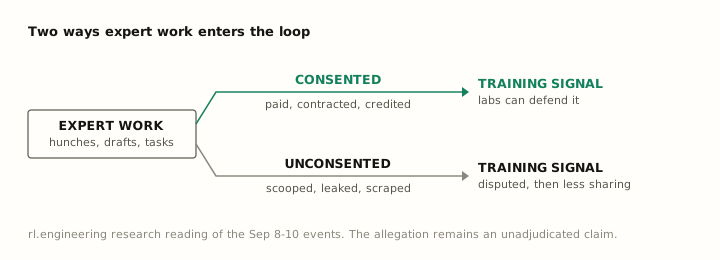
Because the vendors this site tracks sell one thing: expert work the expert agreed to sell, on terms that record who supplied it. The economics of selling RL environments work because experts are paid, credited, and contracted for the signal the loop consumes. The vendors advertise it: sole-data-partner deals, co-built evaluations, expert networks with recruitment and review. Each of those arrangements is a provenance guarantee sold to a lab.
The Navier-Stokes week showed the alternative: signal that enters the loop without consent produces disputes, resignations, and researchers announcing they will share less. That outcome is expensive for every lab and vendor that depends on experts continuing to produce trainable work. In our judgment, provenance terms (who saw the work, when, and under which agreement) will become a headline feature of expert-data deals rather than a contract detail.
What this means
In our judgment, trusted access to expert work has become the scarce input: a lab that can run 10,000 agents for 88 hours can finish any leaked hunch. Labs now need to know whether the expert agreed to supply each signal they use, and the vendors that can document that agreement, with the expert-authored ground truth labs already trust, are selling what labs visibly need.
FAQ
What is the Navier-Stokes Millennium Prize problem?
The Navier-Stokes Millennium Prize problem is one of seven problems the Clay Mathematics Institute designated in 2000, each with a $1 million prize. It asks whether solutions to the equations governing fluid motion always remain well-behaved or can develop a singularity in finite time. OpenAI’s announced proof says a singularity can happen.
What does Levent Alpöge allege?
Levent Alpöge, a Harvard mathematician, says that before the announcement OpenAI had learned about his private, unpublished work on the problem and had assembled a group to compete with him, and that he raised this with the company on September 2. OpenAI’s Sebastien Bubeck replied that nothing was locked and that the company had been willing to talk. No independent adjudication existed as of September 10, 2026.
What is a Lean formalization?
A Lean formalization is a version of a proof rewritten in the Lean proof assistant, a language a computer can check line by line. A formalized proof can still be about the wrong theorem, but it cannot contain a hidden logical gap, which is why formalization mostly settles correctness disputes.